



The conversations around mental health have changed dramatically over recent years, and some of the stigma associated with having a mental health condition has lessened. But we can do more. We can do more for ourselves, our friends and family members, our neighbors, and co-workers. The “more” begins with understanding, listening, learning about the available resources, and recognizing when those around us are in need.
Words and phrases such as “depression,” “bi-polar,” “anxiety,” and “post traumatic stress disorder” are part of our communication but do we really know what they mean? How are we educating ourselves? And how are we understanding the interactions between individual mental health, our economic situation, immigration status, public policy, and family situations to name a few variables?
Here’s what we know when it comes to nonprofits and mental health. First, there are many nonprofits dedicated to researching mental health and identifying treatments and new or combined therapies. There are organizations committed to providing referrals, information, and treatment. We also know that individuals working within nonprofits and those served by nonprofits are living with mental health conditions. NAMI, the National Alliance on Mental Illness, is a national, grass-roots organization with a long history of supporting people affected by mental illness. Whether you are suffering, or living with someone who is, there is a program and support for you.
We also want to share information related to “burn out” which impacts so many working-people’s lives, including those who work at nonprofits. We talked with Cait Donovan, co-host of FRIED: The Burnout Podcast in an earlier column, and we recommend her blog and column as a resource and a tool for creating personal – and workplace – change. It’s this latter component of burnout – and mental health – that we want to encourage you to think about as part of Mental Health Awareness Month. While “burn out” is not a mental health illness or condition, it can exasperate people’s mental health, and it is an environmental and organizational condition that can leave people feeling exhausted, stressed out beyond belief which can contribute to physical and mental health issues. And it affects different people differently.
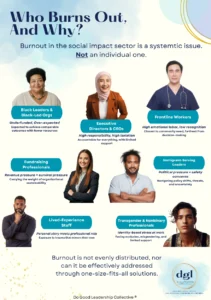 We recently read “Who Burns Out, and Why?” from the Do Good Leadership Collective, written by Loretta Turner, MA, ACC and edited by Florine Causer. This report makes the case that “burnout is directly tied to workplace conditions…” and that “Black professionals, particularly those leading Black-led organizations, face disproportionate burnout risk due to longstanding structural inequities.” Turner identifies the following as being at higher risk for burnout: executive directors & CEOs, frontline workers who provide direct services, fundraising professionals, those working within immigrant-serving organizations, individuals whose lived experience matches those they are serving, and transgender and nonbinary people.
Burnout and stress can contribute to or exasperate mental health challenges. Taking the time to look at the environments that we are asking people to work within is one way to support each other and help reduce burn out and improve mental health. We encourage you to take time to read Turner’s report.
© 2026 Mel and Pearl Shaw, authors of “Prerequisites for Fundraising Success.” We provide fundraising counsel to higher education, nonprofits, and philanthropy. Video conferencing always available. Visit www.saadandshaw.com.