


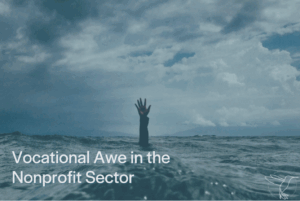
 Have you heard the phrase “vocational awe?” We were first exposed to it when reading the blog post Lead without losing yourself: My experience with vocational awe in the nonprofit sector by Shannon Parris. The phrase describes many behaviors we have witnessed within nonprofits over the years. We summarize vocational awe as the feeling of being so blessed to have the opportunity to work with mission-driven organizations or institutions that we shouldn’t complain, ask for fair compensation, or prioritize our health, family, or personal obligations over work. You may hear it from yourself and your peers in statements such as, “I can’t believe how lucky I am to have this job; I can’t believe I’m being paid to do this!” That’s the positive side.

Shannon Parris
Parris describes the negative side. “A few years into my career in the nonprofit sector, I was 27 years old, and I had two stomach ulcers and a case of shingles. I had a job that I thought I could do until I died, and it was slowly killing me. This job asked me to do a lot of things that I’ve since come to notice as unfortunate patterns in the nonprofit sector. I paid for things that the organization should have paid for and made valuable contributions of personal assets without reimbursement. I worked more hours than I should have, according to the salary I was being paid. I lacked boundaries between my professional and personal life and allowed myself to be mistreated by my supervisor. I was willing to do anything “for the mission” and put it above everything, including my health and personal relationships. I derived my feelings of self-worth from my job, and I liked spending time only with people who knew me at work.”
Click here to read Shannon’s blog post.
While there are many factors influencing the phenomenon of vocational awe, there is something that each of us can do to help reduce the negative impacts. Yes, we need to look at “other duties as assigned” and how this influences individual and collective health. But there’s more to it than that. We – all of us – need to talk about what’s going on, name it, and work together to restore balance. The results of ignoring this reality can snowball, creating harm for employees, the nonprofit itself, and the people served or advocated for.
Here’s what we know: nonprofit capacity is at the heart of being able to deliver on mission and vision. And the heart of capacity is people. If you’re in management or leadership, you have to treat people right. If you are working for a nonprofit, you have to take care of yourself and support your coworkers as they take care of themselves. You have to have boundaries and self-respect, and the support of others. Let’s get to work.
To embark on a new path, register to join Parris and others on Thursday, November 13 at 1:00 pm ET to brainstorm ways to set boundaries, reclaim joy in our work, and build sustainable, energizing.
© 2025 Mel and Pearl Shaw, authors of “Prerequisites for Fundraising Success.” We provide fundraising counsel to higher education, nonprofits, and philanthropy. Video conferencing always available. Visit www.saadandshaw.com.